
Britain is braced for its best solar eclipse in decades tonight, with the looming celestial spectacle having captured the nation's imagination.
Between 6.17pm and 8.06pm, more than 90% of the sun will be obscured by the moon – the most it has been blocked above the UK skies since 1999.
Excitement has been closing in on fever-pitch levels in recent days, with shops across the country – plus national parks and the Royal Greenwich Observatory – having sold out of the special glasses needed to watch safely.
The latter has sold 15,000 pairs in the build-up to the eclipse, which will be about as good as it gets for British skywatchers until a full eclipse in 2081 (that's 55 years away, if you're counting).
As Sky's science and technology editor Tom Clarke says: "This is a stellar opportunity not to be missed."
Daylight to twilight – what will you see in the UK?
As it's a partial eclipse, it won't be a case of total darkness. But there will still be some slightly "end of the world" vibes, given it'll look like a giant bite has been taken out of the sun when the moon moves across our view.
Enough of the sun will be covered to make a noticeable difference in the temperature and light levels, according to the Royal Observatory Greenwich, making it feel close to dusk or dawn. It may well make for a welcome reprieve from the scorching heatwave, at least for a while.
The clearer the skies are this evening, the more drastic the shift will feel. And the further southwest you are, the more sun will be covered (95% in Cornwall, compared to 90% in London).
And it goes like this...
You will initially see the first contact – when the moon starts to cover the sun.
Then you will see its maximum when most of the sun is covered.
And finally, the end of the eclipse.
A partial eclipse will also be seen in other parts of Europe, Canada and parts of northwestern Africa.
The island of Mallorca, a popular Spanish resort, will be "one of the best places in the world" to watch it, according to Sky's Europe correspondent Alistair Bunkall.
What's the deal with these glasses?
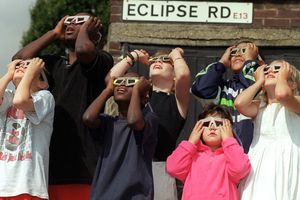
They may look like the kind of spectacles you'd don in the cinema to watch the latest Spider-Man film in 3D, but there's much more to them than that.
And it's a serious matter. Ahead of the eclipse, experts are warning people not to use "knock-off" glasses and to avoid looking directly at the sun.
Only special solar eclipse glasses that are ISO 12312-2 certified for the safest eye protection should be used. To give you some sense of them, NASA says they are "thousands of times darker" than sunglasses.
Following the 1999 total solar eclipse, the Royal College of Ophthalmologists reported around 70 cases of people experiencing vision problems after watching the eclipse. Around 40% had looked at it for less than a minute.
Mohamed Elalfy, president of the Royal College of Ophthalmologists, said: "Looking directly at the sun during a solar eclipse can cause damage to the retina, potentially damaging the cells responsible for sharp central vision.
"Crucially, the retina has no pain receptors, so people will not feel the damage as it happens.
"Symptoms may only become apparent several hours later and can include blurred vision, a central blind or dark spot, distorted vision, reduced colour perception and increased sensitivity to light."
The American Astronomical Society advises these three steps to check if your glasses are safe:
• Put them on indoors and look around. You should not be able to see anything through them, except perhaps very bright lights, which should appear very faint through the glasses.
• Take them outdoors in sunlight and try them on again. You still should not be able to see anything, except possibly a slight reflection of the sun off a shiny surface or a puddle.
• Now glance at the sun through them for less than a second. You should see a sharp-edged, round disc that's comfortably bright without being overwhelming.
If you are photographing the eclipse, use a certified solar filter on your camera or telephoto lens.
A tripod can help keep images steady in low light, while wider shots showing the changing landscape and people's reactions often produce more memorable pictures than close-ups of the sun.
Use less electricity during eclipse, public urged
Special glasses might be a must, but one thing you might want to avoid using is electricity: Britain's biggest energy supplier, Octopus Energy, has urged customers to use less during the eclipse.
The company says when the moon covers the sun, "a huge chunk of Britain's solar power will be knocked out – just as millions of people are getting home and electricity demand spikes".
"To help take the strain off the grid, we're asking Octopus customers to use less electricity during the eclipse and, instead, head outside to enjoy this one-off celestial spectacle," it said.
What about the total eclipse?
If you're reading this on the morning of Wednesday, 12 August, in the UK, you are cutting it a bit fine.
To see the total eclipse, you will have to join the many tourists expected to have travelled abroad for the ultimate experience. The path of totality – where the moon completely covers the sun – begins over Greenland before crossing Iceland and ending in northern Spain and the Balearic Islands.
According to NASA, a small, remote region in northern Russia will experience totality at midday, while for those in Greenland and Iceland it will come in the late afternoon or early evening.
In Spain and the very northwestern tip of Portugal, the sun will not be fully eclipsed until the late evening. The aforementioned Mallorca will be a great place to experience the eclipse.
But the sun will only be fully eclipsed for less than two minutes for the majority of those who manage to see it.
But there's more...
In an added bonus, the annual Perseid meteor shower reaches its peak tonight too, hours after the eclipse.
The meteor shower is produced as Earth ploughs through a stream of dust left behind by Comet Swift-Tuttle. Each tiny grain strikes the atmosphere at about 36 miles per second, burning up in a brief flash that takes the appearance of a shooting star.
NASA says about 50 to 100 meteors per hour may be visible under ideal conditions. The best time to see the Perseids here in the UK is between midnight and 5.30am. You can read our full guide to the shower here.
Watch and follow live coverage on Sky News
"The safest way to enjoy the eclipse is to observe it indirectly, such as by watching a live broadcast," says the Royal College of Ophthalmologists' president Mohamed Elalfy.
You can watch a special programme live on Sky News from 5pm until 9pm tonight, from locations in the UK, Ireland, and Spain.

(c) Sky News 2026: Britain set for its best solar eclipse in decades - here's everything you need to know
 Local news content from CItiblog - read more at
  Spotify to add 'AI Persona' badges to flag AI-generated artists
 British driver who broke sound barrier sets new record in hydrogen-powered car
 UK weather: Amber heat health alerts issued across England as fifth summer heatwave on way
 The 1999 solar eclipse in pictures - and why you should probably get new glasses this time